Showing posts with label 2006 election. Show all posts

15 November 2006

House of Representatives update

From the Seattle Post-Intelligencer:
The great blue wave that swept Republicans out of Congress from coast to coast wasn't enough to sway Seattle's ticket-splitting suburbs.

Republican Rep. Dave Reichert, a freshman who barely won in 2004, held on to his seat in another close race by defeating Democratic neophyte Darcy Burner, a former Microsoft Corp. manager.

Reichert's lead grew to 5,767 votes on Tuesday, or 51.3 percent to Burner's 48.7 percent. Overall, 220,083 votes had been counted in the race.

From the Associated Press via Yahoo! News:

  • Georgia, 12th District: First-term Democratic Rep. John Barrow led Republican former Rep. Max Burns by fewer than 900 votes. An automatic recount is likely once results are certified, which is expected Wednesday.
  • New Mexico, 1st District: Republican Rep. Heather Wilson led Democrat Patricia Madrid by fewer than 1,500 votes out of more than 200,000 cast, with about 3,700 ballots remaining to be qualified and tallied.
  • North Carolina, 8th District: Rep. Robin Hayes, a Republican, led Democrat Larry Kissell by about 450 votes. About 1,500 provisional ballots remained to be counted. Final results aren't expected until Friday.
  • Ohio, 2nd District: Rep. Jean Schmidt, a Republican who called decorated Vietnam veteran Rep. John Murtha a coward, was ahead of Democrat Victoria Wulsin by about 2,800 votes. Workers were to begin counting provisional and absentee ballots next week.
  • Ohio, 15th District: Rep. Deborah Pryce, a member of the House Republican leadership, leads Democrat Mary Jo Kilroy race by 3,536 votes. Thousands of provisional ballots will be counted beginning Sunday — a day later than normal in deference to the Ohio State-Michigan football game Saturday.
  • Wyoming, 1st District: Republican Rep. Barbara Cubin led Democrat Gary Trauner by about 1,000 votes in preliminary results that were to be certified Wednesday. Trauner likely would have to request and pay for a recount.
  • In addition, Rep. William Jefferson, D-La., the subject of anFBI bribery investigation, will face fellow Democrat Karen Carter in a Dec. 9 runoff, and Rep. Henry Bonilla, R-Texas, will face Democratic former Rep. Ciro Rodriguez in a yet-unscheduled runoff to happen no sooner than Dec. 12.
  • In Florida, a first recount was completed Tuesday in the contest for the seat Rep. Katherine Harris gave up to make her failed Senate run. The Associated Press has declared a winner in that race: Republican Vern Buchanan, who leads Democrat Christine Jennings by about 375 votes, or less than 0.02 percent.

10 November 2006

Undecided House races

In this post I talked about the 13 undecided House races. The list is now down to 10.

Projected Republican losses:

CT-02: Simmons (R)

Projected Democratic holds:

GA-12: Barrow (D)
LA-02: Jefferson (D)

Projected Republican holds:

NM-01: Wilson (R)
NC-08: Hayes (R)
OH-02: Schmidt (R)
OH-15: Pryce (R)
WA-08: Reichert (R)
WY-01: Cubin (R)

Unknown:

TX-23: Bonilla (R) in unscheduled run-off

Projected final tally is 232-202 with TX-23 undecided. The Democrats had 202 seats and one independent in the 109th Congress. USA Today is projecting 232-203 as the final tally.

Media bias? No way!

I found this one over at NRO:

The front page of the Washington Post's Style section has featured the following headlines in the last two days:
  • Pride of Baltimore: Nancy Pelosi Learned Her Politics At the Elbow of Her Father the Mayor
  • Muted Tones of Quiet Authority: A Look Suited to the Speaker
  • Power Cleaning: As Democrats Take Over the House, Republicans' Perks May Go Out the Window
The front page of the Style section featured the following headlines in the days after the 1994 election:
  • The Day After: Sifting Through the Wreckage
  • How the Gingrich Stole Christmas

08 November 2006

Bullseye on 2008

In this post I talked about the seats Republicans lost due to scandal or other self-inflicted reasons. All but one of those seats are generally Republican territory. So they immediately go to the target list for 2008.

This from Stephen Spruiell at NRO:
At a luncheon on the Hill today sponsored by FreedomWorks (audio from speech here), Republican pollster Ed Goeas said that the losses we saw last night are average for mid-term elections, particularly mid-term elections in a time of war. He also said, “One of the things that is different from 1994, is that in 1994 when Republicans won 56 House seats, all but a handful were won by a range of 10 or more percent. Last night if you look at the election, of those 28 House seats, 22 were won by 2 percent or less — 22 of the 28. And of those, 18 were won by less than 5,000 votes, and four of those by less than a thousand votes.” Later he went over the numbers again, and concluded, “In other words you can basically go back and say that we lost control of Congress by 11 seats. You’re talking about less than 50,000 votes.”
We can add those seats (although some of them fit in the same category as above) to the list as well. If we assume that the Republicans will need 14-15 seats to take back the House in 2008, these seats are where they will start.

Not all gloom for conservatives

Despite the Democratic gains, there were some bright spots in yesterday's election for conservatives:
  • "Michiganders voted overwhelmingly on Tuesday to amend their state's Constitution to ban public colleges and other state agencies from operating affirmative-action programs that grant preferences based on race, color, ethnicity, national origin, or gender." See here.
  • Seven states (Colorado, Idaho, South Carolina, South Dakota, Tennessee, Virginia, and Wisconsin) passaged marriage amendments. Only one (Arizona) was defeated (and by a 49-51 margin).
  • While the race hasn't been officially called yet, Minnesota Governor Tim Pawlenty (incumbent Republican) is leading by 14,000 votes. In the 1% of unreported precincts (almost exclusively small and rural), it does not appear that there are enough votes for the margin to get much smaller.

House of Representatives

CNN's current tally is 227-195 in favor of the Democrats with 13 races undecided yet (although most of them are reporting 100% of precincts).

Projected Republican losses:

CT-02: Simmons (R) losing by less than 200 votes, recount likely.
PA-08: Fitzpatrick (R) losing by 1,500 votes.

Projected Democratic holds:

GA-08: Marshall (D) winning by less than 2,000 votes.
GA-12: Barrow (D) winning by slightly more than 3,000 votes.
LA-02: Jefferson (D) winning with less than 50%, will win runoff.

Projected Republican holds:

NM-01: Wilson (R) winning by 1,300 votes.
NC-08: Hayes (R) winning by 500 votes.
OH-02: Schmidt (R) winning by 2,300 votes.
OH-15: Price (R) winning by almost 15,000 votes.
PA-06: Gerlach (R) winning by 3,000 votes (definitely a surprise hold for the Republicans).
WY-01: Cubin (R) winning by 800 votes.

Unknown yet:

TX-23: Bonilla leads with 48% but will need a run-off.
WA-08: Reichart (R) winning 51/49 with lots of votes to count.

Almost final tally: It appears the Democrats will pick up about 30 seats total; the Republicans will have at least 200 seats and possibly a handful more. The Democrats had 202 seats and one independent in the 109th Congress. It looks like a mirror reversal.

EDIT: USA Today projects the final tally to be 232 for the Democrats to 203 for the Republicans.

Election recap

First of all, let's give credit where credit is due. The Democrats won this election and should be congratulated for it. Chuck Schumer and Rahm Emanuel did a wonderful job recruiting candidates for the Senate and House, respectively.

Republicans need to realize and acknowledge the defeat. From Jim Geraghty at NRO:
Every two years, the country has a choice. Sometimes the country's going to agree with you; sometimes they won't. Sometimes you'll be convinced you have fantastic arguments, and the other guy doesn't know what he's talking about. And yet sometimes they choose the other guy. Sometimes you lose. It stinks, but it happens.

What do you do? You mope. You drink. You swear a bit.

And then, after a little while, you get back up on the horse and try again.

Regarding this, I think the Democrats have inferior policies. But the country chose 'em; now they get to see how they work.

My congratulations to tonight's winners; chin up to the losers. Tomorrow is another day.
So we'll eat our piece of humble pie, but the optimism never stops. This is grace in defeat.

Now let's get down to the analysis.

Which headline sounds better:

"TIDAL WAVE SWEEPS DEMOCRATS INTO CONGRESS"

or

"DEMOCRATS HAVE AVERAGE SIX-YEAR MIDTERM"

Clearly, the first one sounds better. But in reality, the second one is more accurate. Remember what I said about mid-term elections?
...we can expect the Democrats to win at least 30 House seats and at least 4-5 Senate seats.
With some seats undecided, the Democrats have won 28 House seats (and will probably win a few more) and four Senate seats (with the likelihood that it will eventually be six.

As for my predictions, it appears that I will be off by about a dozen seats, although I did expect the House would go to the Democrats. I suspected the Senate would be very close; I predicted it would remain Republican but it does appear the Democrats will probably gain control of that chamber as well.

Also, do not forget what I said about this year's crop of Democratic candidates. Most of the Democratic takeovers were by conservative Democrats. On the flip side, many (but not all) of the Republican losses were by moderate and liberal Republicans. Here is the very unique situation: despite the fact that the House of Representatives has changed hands from Republicans to Democrats, the political dynamic has not really changed all that much.

Next, let's look at those seats the Republicans lost due to outside reasons (i.e., scandal): AZ-05, CA-11, FL-16, NY-20, NC-11, OH-18, PA-07, PA-10, and TX-22. Other than PA-07, These are all generally Republican districts that will be tough fights in 2008 for the Democrats to hold. If I were making a 2008 "cheat sheet" they'd be the first districts on my target list.

Finally, consider this:
Nancy Pelosi (D) is viewed favorably by 24% and unfavorably by 44%. Those figures include 8% with a very favorable opinion of the Democratic leader and 26% with a very unfavorable view.
Let the fun begin.

Final turnout numbers

In my precinct (State College Southeast), Centre County, Pennsylvania:

2002 Midterm: 900 registered voters, 608 votes (67.56%).

2004 Presidential: 1,011 registered voters, 889 votes (87.93%).

2006 Midterm: 982 registered voters, 615 votes (62.63%). Lower than 2002! So much for increased turnout.

07 November 2006

Turnout so far

In my precinct (State College Southeast), Centre County, Pennsylvania:

2002 Midterm: 900 registered voters, 608 votes (67.56%).

2004 Presidential: 1,011 registered voters, 889 votes (87.93%).

2006 Midterm: at 1 PM when Tracy voted, approximately 390 people had already voted. There were 816 registered voters in the precinct at the time of the primary election; I'm not sure how almost 200 voters disappeared from the rolls in two years unless the precinct boundaries were slightly redrawn. With the number of apparent valid votes in 2004, there doesn't seem to have been much room for "cleaning up" the rolls.

As you can see turnout in this precinct is traditionally higher than national averages. Based on the numbers of voters so far, it seems likely the precinct could exceed turnout from 2002 but I doubt it will come close to 2004.

Also it appears my absentee ballot isn't there yet. This has me slightly worried but it wouldn't surprise me if my ballot was lost somewhere in this military mail system. As for absentee ballots in general, Pennsylvania is not so liberal as other states in voting that way. You have to have a reason to vote by absentee as opposed to many other states that allow absentee and early voting without the voter having to justify a reason.

Political ads

Michael Steele ad about stem cell research:

Political ads

This ad is running against Jim Walsh, Jim Talent, and other Republicans in Missouri. Looks like the Dems know very well how to pull at your heartstrings. Who could disagree with a cute little girl? Borders on shameless. If this isn't desperation, I don't know what is.

Political ads

This ad is running in New Mexico in the highly contested First District between Heather Wilson (R) and Patricia Madrid (D).

Democratic backfire?

If, as widely expected, the Democrats take over the House of Representatives (and possibly the Senate) as a result of today's elections, it will be because the Democratic Party has been successful winning back seats in traditionally Republican districts.

You might wonder: why would a traditionally Republican district vote for a Democrat this time? Is the war really that bad? What is the difference?

The difference is that many of these Democrat candidates are so-called Blue Dog Democrats (or what used to be called Boll weevils). In other words, they are (generally) conservative Democrats. Many of them are pro-life. Many of them are pro-gun. For many of them, if they had (R) behind their name instead of (D) it wouldn't be much of a difference. In fact, some of these types of Democrats have switched parties: Senators Phil Gramm of Texas and Richard Shelby of Alabama were once "boll weevil" Democrats. Representatives Billy Tauzin and Jimmy Hayes (both of Louisiana) were once "Blue Dog" Democrats who later switched parties.

The Democrats have recruited many of these Blue Dog Democrats and backed them with money from the party and other politicians (most of whom are moderate or liberal Democrats). This is a calculated strategy, but it could backfire. While some of these conservative Democratic candidates have said they haven't yet pledged their speaker vote to Nancy Pelosi, I'd be generally surprised if any of them didn't vote (especially because of the money coming their way from the Party). However, if these Democrats tend to vote their minds instead of their party (which is likely given their history), they could make the Republican minority a functional majority for many issues.

Finally, there has been some talk of party-switchers, and if any, they would be these such conservative Democrats switching to the Republican side. As with the vote for Speaker, this would surprise me a little bit, at least between now and January. Whether some of these candidates switch later down the road, that's another story.

06 November 2006

Election day trivia

Election Day is the first Tuesday following the first Monday of November every year (November 2-8 depending on the year). But why?

From About.com:
  • November was selected because the harvest work was done.
  • Tuesday was selected because many people had to travel the day before to reach the polling place. Since most people did not travel on Sunday for religious reasons, they did not want it to be on a Monday.
  • They did not want Election Day to fall on November 1st because it is All Saints Day.
  • They did not want Election Day to fall on the first of the month because many shop keepers did their books for the preceding month on the first.

ELECTION DAY!

Today, November 7th, is Election Day. It is not really a holiday, as most people work and most schools will be open, but it is perhaps one of the most important days of the year because it defines who we are as a people. Do not take for granted that the balance of power from one party to the other (and back again) comes about in our country by a free and open process, not by a preordained succession, military coup, or other violent means.

I always encourage people to vote Republican, but really I just want people to go out and vote, period. One of my biggest pet peeves are people who constantly complain about our government, but never bother to actually get out and vote. As far as I am concerned, your decision to vote convinces me that you care enough about the direction of our country for me to listen to your opinion.

If you aren't sure where to vote, check your local newspaper, the Internet, or your local elections office. We have a system in Centre County where we can type in our personal information and it gives you the location of your polling place (although I do have some privacy concerns about it). Other areas undoubtedly have similar types of systems.

You might see a new voting system, too. Centre County has moved to touch-screen voting (there's even a demo here). I've asked Tracy to check it out for me so I expect to have more on that later today or tomorrow. Of course, having been registered in Pennsylvania since I was 18 and being outside of the state (and country) since 1999, I have probably voted by absentee ballot more times than I've actually been in a voting booth!

In Pennsylvania, the polls are open from 7 am until 8 pm. Again, check your newspaper for poll hours in your state.

Get out and VOTE!

05 November 2006

Election predictions, part 3

Here is part 3 of my election prediction series.

House of Representatives

Currently, Republicans hold 232 seats; Democrats 202 seats, and 1 independent. Democrats need to win 15 seats to gain control of the House of Representatives (the independent is Vermont's Bernie Sanders, who caucuses with the Democrats; his seat is expected to be won by a Democrat and thus the independent counts for them).

Right now I see the Democrats picking up a minimum of 10 seats and possibly as many as 24. I don't think it could go much higher than that.

It was widely suspected that Democrat incumbents would not lose any seats, but it appears at least in the realm of realistic possibility that one or two could lose. If any do, it would most likely be Marshall (GA-8) or Barrow (GA-12).

Senate

It was once thought that the Democrats had a reasonable chance to take over the Senate, but with the latest polls I see that being a straight uphill battle. Currently there are 55 Republicans, 44 Democrats and 1 independent (again, read Democrat for caucus purposes). Democrats need to win six seats to win, which would put them over the top, 51-49. A 50-50 tie would leave the Republicans in the majority because the Vice President would break ties.

The incumbent Republican Senators most likely to lose are (unfortunately) Rick Santorum (PA) and Mike DeWine (OH). Lincoln Chafee of Rhode Island is probably also in this camp, although one recent poll had the race a toss up.

Jim Talent in Missouri, Conrad Burns in Montana, and George Allen in Virginia are all in races I would call dead heats. They really could go either way. Neither candidates have significant momentum leaving the weekend.

Democrats need all six of these races to win the Senate. However, they also need to hold onto Maryland, where Lt. Gov. Michael Steele (R) is running a spirited campaign against Democrat Ben Cardin. Into the final stretch this race is now a toss up with many expecting Steele to pull it out.

Bob Corker is running for Bill Frist's seat in Tennessee against Democrat Harold Ford, Jr. in a race that has been close all season, but Corker has opened up a significant lead in the final two weeks. Finally, Republicans expect to hold onto Jon Kyl's seat in Arizona.

Final predictions

House of Representatives: Democrats 223, Republicans 212

Senate: Republicans 51, Democrats 49 (47+2 independents)

Election predictions, part 2 redux

Charles Krauthammer's op-ed piece at the Washington Post basically argues the same point I made in my election prediction (part 2):
What to say about such a victory? Substantial, yes. Historic, no.
...
So when the results come in and the Democrats begin to crow, remember this: By historical standards, this is the American people's usual response to entrenched power -- a bracing and chastening contempt. Sixth-year presidents nearly always bring their parties down.
...
The election will be a referendum of sorts on Iraq. But it will be registering nothing more than uneasiness and discontent. Had the Democrats offered a coherent alternative to the current policy, one could draw lessons as to what course the country should take. But if either friends or enemies interpret the results as a mandate for giving up, they will be mistaken.
Nice to see someone agrees with me!

Political ads

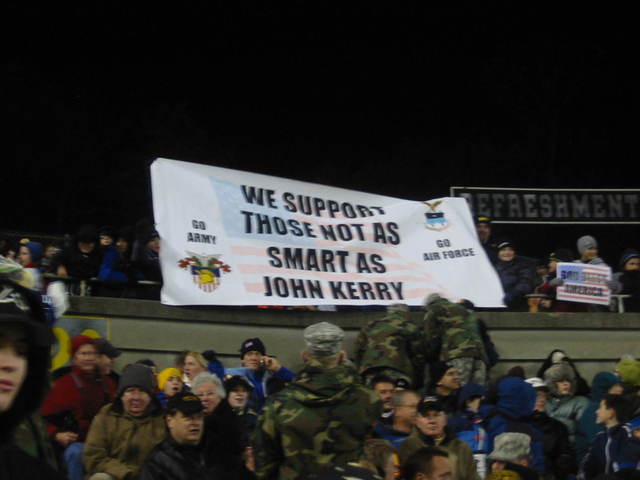
Today's laugh

From the Army-Air Force game:

04 November 2006

Election predictions, part 2

In part 2 of my election prediction series, I want to talk about the history of midterm elections. Why, you might ask. And that's a good question. The reason is because I think it is important to understand the dynamics that come into play during a midterm election so that you can understand how the results come to be.

First, let me define what I mean by a midterm election. As we know, every four years is a presidential election year. 2000, 2004, 2008, and so on. Those elections between those years are midterm elections, so by midterm I mean mid-presidential term. 2002, 2006, etc.

Midterm elections are almost always won by the party opposite the president's party. That is, history shows us that no matter what the situation, the party in power in the White House almost always loses seats in Congress.

Consider these numbers:
The average first midterm election loss for every elected president since 1914 is 27 House seats and three Senate seats. The average sixth-year midterm election, like this year, is much worse for the president's party, which typically loses 34 seats in the House and six seats in the Senate.

This makes the average loss in two midterm elections for the party in the White House: 30 House seats and four or five Senate seats in each midterm election.
What this means is that just by historical average, we can expect the Democrats to win at least 30 House seats and at least 4-5 Senate seats.

Also consider the fact that in 2002, the Republicans actually gained seats in both the House and Senate, the first time any president's party has gained seats in a midterm election since 1934!

According to Real Clear Politics, twelve current Republican seats lean Democratic. A further 18 remain in the toss-up category. Assuming that the Democrats can win 2/3 of the toss-ups, the Democrats will net 24 seats in the House. It will give them the House of Representatives back, but it still falls short of the historical average.

In the Senate, three Republican seats lean Democratic. A further three are toss-ups. The Democrats would have to win all six of these seats, and fend off a late challenge by Michael Steele in Maryland to take control of the Senate. As it looks now, the Democrats should be happy just to meet the historical average of 4-5 seats.

What does all of this mean?

Despite the possibilities of significant Democratic gains in both the House and Senate (with the House more likely to end up Democratic), their projected gains are still falling short of what one would expect. I think this is a result of two things: first, people are souring on the war, and voting "against" the President because of it. Second, the Democrats have no message. They seem to be "against" everything, but "for" nothing. The result is that people are more likely to vote against Republicans than for Democrats. This might give the Democrats some new political power, but it really doesn't change the underlying political landscape.

Tomorrow: my predictions.