Showing posts with label firearms. Show all posts

14 June 2016

On civility in political discourse

Part of the header on my blog says "promoter of civility in political discourse." I take that seriously. It's the standard I set for myself and it's what I expect of the people I associate with. This means forgoing the friendly confines of the echo chamber and engaging with people of all political persuasions. My list of friends and followers reflects that choice. I believe respectful discussion of issues from all different sides, especially sides we don't necessarily agree with, makes us all better because it exposes us to different perspectives and allows us to hone our own arguments. Underlying this exchange, of course, is civility.

The recent tragedy in Orlando has brought this approach into sharp focus. While most have continued to be civil, others have been less so. In particular, I am disappointed with incoherent attempts at arguments based solely in emotion, ignorant of history, circular in reasoning, and accentuated by ad hominem attacks. This does nothing to advance your position; it's quite the opposite. This does nothing to promote civility; it's quite the opposite. This does nothing to promote healing. It encourages the very echo chambers we ought to be avoiding. It does nothing to bring us together; it does everything to push us apart.

I welcome well-reasoned arguments in opposition. But please do so civilly. If you can't, I have no time for you.

13 June 2016

The Orlando shooting and the FDA's blood donation policy


I don't like the FDA. I really, really, don't like the FDA (but that's a subject for another day). Nonetheless, the FDA, as advised by the FDA Blood Products Advisory Committee and the HHS Advisory Committee for Blood Safety and Availability (now the HHS Advisory Committee for Blood and Tissue Safety and Availability), determined in December 2015 that it would only accept blood donations from men who have had sex with other men (MSM) if they did not have MSM contact within the last 12 months (the previous policy was an outright lifetime ban on such donations). It's unfortunate that such men who are willing to donate are not permitted to donate blood under the circumstances, but those committees that advise the FDA are made up of practicing doctors who specialize in these issues. They presumably have very good reasons for making these recommendations. Good medical reasons. You know, like science stuff. As much as I really, really, don't like the FDA, I trust the recommendations of these doctors more so than I trust the well-meaning recommendations of random people on social media. If you believe you have compelling reasons why the FDA should change course, I'm sure they've love to hear from you.

18 May 2016

"Sir, what do we do?!"


During the early summer of 2006, I was in a seven vehicle convoy just north of Baghdad, Iraq. I had only been in country for a short time. I was riding in the passenger seat (or "truck commander" seat) in the second vehicle. Our Humvee was modified to carry electronic countermeasures equipment, and as a result, we had no .50 cal gunner (similar to the Humvee on the right in the picture above). It was just me and a young Army soldier driver.

As we passed through northern Baghdad, I noticed a flash in my side view mirror. We soon realized that an IED had gone off behind our vehicle and in front of the third vehicle. A quick comms check revealed that, thankfully, no one was injured. A quick inspection found only minor damage to the vehicle. Nonetheless, we stopped to investigate.

The lead Humvee sped off to the right to investigate a taxi that was driving away from the scene.

"Sir, what do we do?!" My young driver and I realized at the same time our now-awkward situation. The normal procedure under these circumstances was for the lead and trail vehicles to drive 400-500 meters and set up a cordon. This would allow the other teams to investigate while providing standoff distance for approaching vehicles. Since the first vehicle followed the taxi, we were now the lead vehicle, but without the powerful Browning machine gun to support us. Keep in mind that I'm a Navy officer; a naval flight officer trained in electronic countermeasures. I had two weeks of "Army" training. I was not intended to be involved in ground combat. Nonetheless, here I was.

I immediately explained to the driver to move and set up the cordon. He drove us half a kilometer forward, blocked the road, and then disembarked so we could provide some measure of support. It was not ideal, but it worked. For a few tense minutes, our only method to project power was M-16s or M-4s--hardly the kind of weapon you would want to deter another vehicle. Fortunately, another Humvee came forward and eventually relieved us.

At that point, we returned back to the scene of the IED. I then followed the lead Humvee to where they had stopped the taxi. One soldier seized a few cell phones, which I held while another soldier swiped the hands of the taxi driver and his passengers with a chemical swab to detect explosives. Then, one of the cell phones rang. Iraqis had been using cell phones to detonate IEDs, but this was just the cell phone. Still, it spooked me.

As we were wrapping up the roadside stop, I heard the unmistakable rat-tat-tat-tat of an automatic machine gun. In that instant I immediately realized two things: first, you don't have explain the sound of an AK-47 to someone under fire. Second, you don't have to teach a Navy guy how to hit the deck. I did so immediately. After absorbing a face full of sand and dirt, we soon realized that the sporadic AK-47 fire was not aimed directly at us. Most likely, it was spray-and-pray fire designed to unnerve us. It was working. We soon hurried back to our vehicles and were on our way.

The Army unit I was with was near the end of their rotation, soon to head home. To them, this was just another day outside the wire. Fortunately, no one was injured. As far as I know, the incident was never written up (such a write-up would be required for a combat action badge or similar award). Yet I remember the incident as if it happened yesterday.

05 November 2013

Get-away driver gets felony murder charge

Monday was a bad day for two armed robbers, who were both shot and killed by a concealed carry holder. It will also be bad for the get-away driver, who wasn't even in the store when the robbery happened:
About nine hours later, Reading police arrested the man they said was the get-away driver in his Fleetwood apartment.
Alexander Garcia Bialek, 21, was taken into custody late Monday with the help of borough police in the apartment building in the first block of North Laurel Street.
Police said witnesses saw the two robbers speaking to someone in a brown SUV before going into the store. Police gathered surveillance video that showed the SUV, then contacted its owner, who said he had lent the vehicle to Bialek.
Bialek was charged with second-degree murder, robbery and conspiracy.
District Attorney John T. Adams said a person can be charged with second-degree murder if he or she is an accomplice to a felony that results in a death.
The fact that Bialek wasn't in the store doesn't matter. The fact that he didn't kill anyone doesn't matter. The fact that it was his partners who were killed lawfully by the concealed carry holder doesn't matter. According to 18 Pa.C.S.A. § 2502:
(b) Murder of the second degree.--A criminal homicide constitutes murder of the second degree when it is committed while defendant was engaged as a principal or an accomplice in the perpetration of a felony...
(d)...“Perpetration of a felony.” The act of the defendant in engaging in or being an accomplice in the commission of, or an attempt to commit, or flight after committing, or attempting to commit robbery, rape, or deviate sexual intercourse by force or threat of force, arson, burglary or kidnapping.
Bialek has some long days ahead of him.

17 April 2008

Virginia Tech goes political

It was unfortunate but inevitable that yesterday, on the one year anniversary of the Virginia Tech shootings, the anti-gun agenda would once again rise up in the form of demonstrations and "lie-ins":
“The right to bear arms was given to us by our forefathers more than 200 years ago,” said Russ Ryan, who participated in the lie-in. “And like some of these other laws that have changed, we need to take a look at gun control.”
So Mr. Ryan just wants to "change" the 2nd Amendment. The article goes on to say:
Authorities have said Seung-Hui Cho, the student responsible for the Virginia Tech shootings, had a history of mental illness, which under federal law should have prevented him from buying firearms.
Now, isn't that interesting. A law that should have prevented this tragedy is already on the books. So rather than enforcing the existing law, people just claim to want more gun control.

I wonder what Mr. Ryan would say if I wanted to "change" his 1st Amendment rights.

19 December 2006

A glorious day

Today we turned in two very full (and very heavy) seabags full of issued gear along with our M-16s and M9s. It has also made traveling much easier as we only have our personal gear left to worry about!

I completed my "post deployment medical screening" which is a check in the box to make sure I'm not going to "go postal" on the neighbors when I get home. Of course, it is a serious business, to help diagnose post traumatic stress disorder and other combat-related illlnesses, but for most of us it is a quick 5 minute procedure.

Tomorrow we'll have to sit through about three hours of briefs and then we'll be done until our flight home (whenever that turns out to be).

16 December 2006

Amnesty box oops

On some of the larger bases (like here in Baghdad for example) they have something called an "Amnesty Box" which is basically a place to put stuff you're not supposed to have ("contraband"). They most often end up being filled with ammunition that was dropped or lost by someone.

I happened to be walking past one of these Amnesty boxes yesterday when two soldiers, whose job it was to empty the amnesty box, were doing just that. I saw the usual assortment of misplaced ammunition and asked if they had found anything interesting. The one soldier replied immediately saying, "Yeah, an MP5."
Nice.

03 August 2006

I'll take one of those

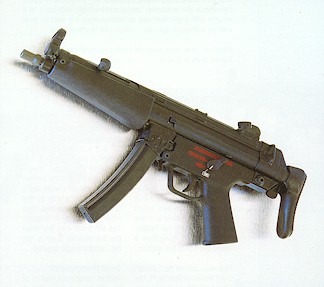
This afternoon I noticed a weapon slung over someone's shoulder that I had not ever seen in person but I recognized immediately:

Gun enthusiasts will recognize (as I did) that this is the Heckler & Koch MP5. Why do I care? Simply because this is a classic among firearms. It would be in the firearm hall of fame, if there was one. It is the standard weapon for tactical teams, law enforcement (SWAT) and military special operations. As one website puts it, the MP5 is "[t]the standard by which all others are judged."

I think any gun enthusiast who hasn't already fired an MP5 would salivate to get their hands on one. The MP5's diopter sights are said to be very easy to learn. I don't expect to have the chance to fire one of these, but if the chance came, I'd take it in a heartbeat.

I won't go on (too much) more about the MP5, but if you're interested, you can read more here, here, here and here.

29 July 2006

"Pimp" my M-16

We were issued M-16A2s. Not the newest variety of course. Many soldiers have M-4s which would have been ideal, but we have what we have.

My goal over the past month has been to make it as useful as possible.

The issued Blackhawk sling is double-looped, easily adjustable with a quick release, and nice for dismounted operations, but we don't do that all that often. And it gets caught on almost anything in the vehicle. Sling removed...

The plastic handguard is crap so I took it off and replaced it with a Knight's Armament weapon adapter rail system.

The rail has an adjustable vertical handgrip and a Surefire Tactical light.

I also added a buttstock magazine holder which is convenient if you need that second magazine fast!

Lastly, I'm thinking about an EOTech holographic sight. Very nice, but unsure if I can get one through supply. They are pricey so I wouldn't want to have to pick one up myself!

02 May 2006

Fort Jackson, Day 9

Day Nine began as usual, with PT. There was no running today, but it didn't make the PT any easier. We did quite a lot of pushups, situps, and all sorts of other things to exhaust the muscles (and everyone seems a bit sore all day because of it).

The morning was dedicated to the classroom portion of the Convoy class. This particular lesson covered the basics of convoys, including their mission, makeup, spacing, speeds, etc. We also covered what to do when encountering an IED, small arms fire, ambushes, etc. This classroom session will be put into reality on Thursday when we man up a convoy and attempt to employ the tactics against an ambush and "enemy" insurgents.

As expected, we spent the afternoon at the range ("Bastogne") firing the heavy weapons we learned about on Saturday: the M240B, M249 (Squad Automatic Weapon, or SAW), M19 Grenade Launcher, and M2 (.50 cal machine gun). My vote for coolest weapon goes to the M19. The muzzle velocity of the grenade rounds is low enough so that you can follow them to the target, and adjust your fire to lob them in the appropriate direction.

A mid-afternoon finish was a nice end to the day, as we had plenty of time to ride the bus to the exchange and out the gate to get something to eat. However, the computer labs are now much fuller as we approach the middle of the week. Those that haven't already completed the required NKO courses (not a small amount) are feverlishly working to finish them. Fortunately, I started a while back and finished over the weekend. Another check in the block!

Tomorrow will be entry control point procedures, urban operations, and more. Wednesday and Thursday will be the last two days of training so we're getting into the more advanced training in the last few days. No more weapons to qualify on, so while physically demanding, it should be a lot of fun.

29 April 2006

Fort Jackson, Day 6

The weekend arrives, finally! Well, almost. Saturday started late (0830 formation as oppposed to 05-something) so most of us got an extra hour or so of sleep. And based on the schedule, we knew it wouldn't be a full day.

The morning was spent doing heavy weapons familiarization. We were introduced to the Mk 19 40mm grenade launcher, the M240 Machine Gun, the M249 Squad Automatic Weapon (SAW), and the M2 .50 Caliber machine gun. We praticed the clearing procedures and the loading and unloading procedures. The goal here was not to make us experts but to familiarize us enough with the weapons to be able to load, use, and unload them if the situation ever presented itself. On Tuesday, we'll get to fire them at the range!

After lunch we headed across the road to the 25 meter range for the M16 flex fire exercise. This consists of three sets of fires starting from the low ready position with two ten round magazines: 4 "double-taps" of aim-quick-kill shots (using 8 of 10 rounds) from 25 meters; 4 more from 15 meters (after the first two is a mandatory magazine change); and then 2 more from 10 meters firing from the hip ("reflexive fire"). There was no qual here, just practice. Hopefully we'll never need to engage anyone at such short distances!

We got back to Camp McCrady before 1600 so the day was over a few hours earlier than normal. Most guys were out of the door quick with cabs to Columbia and hotel rooms waiting since Sunday is a day off. I took the bus to the Fort Jackson PX for some much-needed supplies.

And I'm definitely looking forward to sleeping in tomorrow and resting up some very sore muscles.

28 April 2006

Fort Jackson, Day 5

Day Five of NIACT was more time spent at the range. Those who had already qualified on the M16 (not me) went directly to the range to qualify on the M9. The rest of us who hadn't yet qualified went from Camp McCrady to Fort Jackson to two different M16 ranges. Almost everyone (including me over two different qualifying rounds) did absolutely horrible on the new range (for a variety of reasons), so they basically shut that range down.

En route to the original M16 qualifying range, we stopped by the M9 range and qualified there. We shot 10 practice rounds (any stance) and then qualified with seven rounds in the standing position (in 21 seconds), 13 rounds in the kneeling position (seven rounds and then six rounds with a mandatory magazine change in 45 seconds), 10 rounds in the crouched position (five rounds and then another five with a mandatory magazine change in 35 seconds), and finally 10 more rounds in the prone unsupported position (again, five rounds and then another five with a mandatory magazine change in 35 seconds). 24/40 was sufficient to qual; I shot 30/40 which was not great, but good enough for sharpshooter (24-29 marksman, 30-35 sharpshooter, 36-40 expert).

After lunch we moved back to the original M16 range and I started out with a round of 21 (we needed 23/40 to qualify). With some much appreciated assistance from a Drill Sergeant calling my rounds (high, low, etc.), I shot 29/40 and finally qualified on the M16! I finally found a good sight picture such that I shot 9/10 in the prone unsupported position (skipping the 300m target and saving the round) and 10/10 in the kneeling position.

Finally, it was back to Camp McCrady after a long and hot day. Taking the gear off my shoulders felt especially good considering the emotional lows of shooting so bad in the morning and then qualifying with a really good score in the afternoon.

Tomorrow we get a late start and get to shoot reflexive fire and maybe even some heavy weapons. Now that the qualifying is out of the way, the rest should be more fun!

27 April 2006

Fort Jackson, Day 4

Day Four of NIACT was dedicated totally to M16 group and zero and then qualification (see yesterday's post for an explanation of the grouping and zeroing process). Yesterday we practiced grouping and zeroing on the electronic range, and today we did it on the range (in the rain no less). In terms of the overall group, I finished fairly expeditiously. My groups were all fairly close, started low, and worked their way up to the target in five three-round magazines after the Drill Sergeant raised the front sights.

After zeroing we moved to the qualification range which is a series of 16 "alleys" with popup targets ranging from 50 meters to 300 meters. The process starts with 20 rounds of familiarization; 10 rounds in the prone unsupported position and then 10 rounds in the kneeling position. After the familiarization, the actual qual is 20 rounds in the prone supported position, 10 rounds in the prone unsupported position and then 10 rounds in the kneeling position (a total of 40 rounds). 23/40 is required to qual. Since there was a considerable wait at the range, I didn't get to attempt to qual until late and only got once chance (all the groups before us had two qualification attempts). I didn't qual yet, I still have a ways to go. So back to the range tomorrow morning to try again. After that, it will be on to the M9 qualification.

After zeroing with very tight groupings, I was really looking forward to the qual range. Even after the 20 fam rounds I felt really good, but I guess today was not my day!

26 April 2006

Fort Jackson, Day 3

Day Three of NIACT began with more Army PT. Today it was the 1.5 mile ability run. The Company was split into three groups (A, 8:30 mile pace; B, 9:30 mile pace, and C, 10:30 mile pace). Of course, I was in the C group and expected it wouldn't be too bad. Well, I was wrong. Let's just say the pace was a little bit faster than a 10:30 mile. At that pace, I wouldn't have had any problem keeping up. But since it was considerably faster, I fell back...a bit. I did finish, though! ;-) After talking to people in the other groups, it seems all the groups ran faster than their advertised paces. Oh well. No more running til next week, at least according to the schedule.

After breakfast we headed over to Fort Jackson proper for more marksmanship training. We rotated through several stations: the first discussed the procedures to disassemble, reassemble and clean the M9 (9mm Beretta pistol), as well as proper shooting stance and grip of the weapon. The second station reviewed NBC (nuclear, biological, and chemical) procedures for donning the gas mask and hood. The third station was M16 firing procedures at close range, shooting blanks from 25, 15, and 10 meters.

After lunch we headed back onto the bus across the base to an electronic range to group and zero the M16. This procedure adjusts the mechanical zero sights to the proper settings for the user. It simulates a 300 meter target where you must group 6 of 6 rounds in a 4cm circle (grouping) and then after adjusting the sights (the computer does this for you automatically at the electronic range), 5 of 6 rounds in the center black 4cm circle (zeroing). With exception to a few computer glitches, I grouped and zeroed reasonably quick and I was very happy with my shooting, considering I've never fired the M16 before.

Dinner was at Fort Jackson and then the group was split between those who needed shots and those who didn't (I didn't, thanks to prior planning!). Those who needed shots stayed at Fort Jackson while the rest of us headed back to Camp McCrady.

25 April 2006

Fort Jackson, Day 2

Day Two of NIACT at Fort Jackson began with a very early morning (0530) introduction to Army physical training (PT). After that, the large majority of the day was spent in full gear (including those heavy ceramic inserts for the body armor vest!). Total weight is estimated at 60+ pounds, and by the middle of the day it was plainly obvious. Sore backs, shoulders and feet were very common. Furthermore, the temperatures are increasing significantly (I would estimate it was close to 90 degrees F today).

We were also issued our weapons (M9 and M16) and began "Weapons Immersion", which means you have your weapon(s) with you at all times (with a few exceptions). We also spent the majority of the afternoon in Basic Rifle Markmanship, which included range procedures, practicing the various stances, and some tips and techniques to help us qualify once we get to the range.

By 1800 or so we were finally able to get out of our gear, which was a nice reprieve from the long day. After dinner and locking up our weapons, we were finally done around 1930.

Tomorrow we'll continue with the Army PT regimen and also start working toward rifle qualification.