Last night it rained the entire night. Today it rained the entire day. Everything is a big muddy mess. If there was any doubt, there isn't anymore. The rainy season is now upon us.
The constant threat of rain also means its cloudy a lot more often, which has cut down on my astronomy habit. The moon is just a couple days past new, in the waxing crescent stage, and is up during the day, so that hasn't played a factor, but cloudly, hazy, overcasts days and nights don't do any good for viewing conditions.
I'm not sure if it has to do with the weather or something else, but I've been feeling sick the past 2-3 days. Mostly a sore throat with a cough. A bit of a headache but nothing too serious, at least not yet. I'm hoping I can sweat it out on the treadmill.
Showing posts with label astronomy. Show all posts
Showing posts with label astronomy. Show all posts
25 October 2006


17 October 2006
Astronomy update
I spotted two more satellites last night: the Cosmos 1500 Rocket and the OAO 3 Rocket.
16 October 2006
Astronomy update
Satellite viewing has gotten more difficult lately, primarily for weather reasons. Along with the milder weather I've seen a lot more clouds, especially at night. The sky is also hazier which really hinders viewing conditions. Fortunately the moon is in the waning crescent stage so moonlight hasn't be a factor the past few days.
Early this morning I happened to gaze up at the easily recognizable constellation Orion and as luck would have it a satellite was moving right across it. I noted the time and general direction of movement, and then matched that information with satellite predictions of that time period to determine it was the Lacrosse 5 reconnaissance satellite (a couple of which we have already seen).
As you can see from the picture below, the satellite came into view just below the constellation Cassiopeia and then passed right through the middle of Orion (where I spotted it) on its way past Sirius (the brightest star in the night-time sky) in the constellation Canis Major.
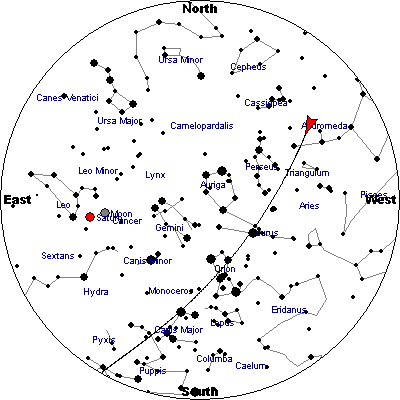
Early this morning I happened to gaze up at the easily recognizable constellation Orion and as luck would have it a satellite was moving right across it. I noted the time and general direction of movement, and then matched that information with satellite predictions of that time period to determine it was the Lacrosse 5 reconnaissance satellite (a couple of which we have already seen).
As you can see from the picture below, the satellite came into view just below the constellation Cassiopeia and then passed right through the middle of Orion (where I spotted it) on its way past Sirius (the brightest star in the night-time sky) in the constellation Canis Major.

07 October 2006
Astronomy update & the harvest moon
Early Saturday morning (4:19 AM) while checking out the constellation Orion I came across an early morning satellite which I later found to be the OAO 3 rocket which was launched on August 21, 1972. Surprising, given the full moon and the satellite's dim nature (4.3). I also saw a very fast moving meteorite a few seconds later on the other side of the sky. Very cool!
Last night's full moon was called a Harvest moon, which is the full moon nearest to the autumnal equinox. Here is a picture of that moon courtesy of Tom's Astronomy Blog:
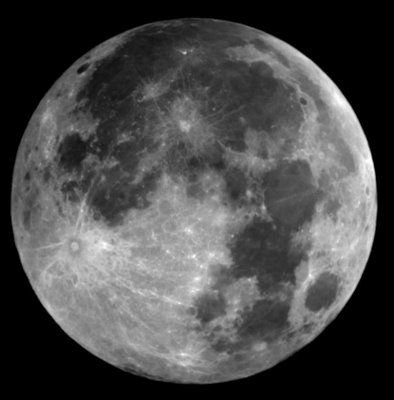
Last night's full moon was called a Harvest moon, which is the full moon nearest to the autumnal equinox. Here is a picture of that moon courtesy of Tom's Astronomy Blog:

15 September 2006
ISS Update
The new solar panels unfurled by the Atlantis crew at the International Space Station should make it even brighter. As always, check out Heavens Above for all things astronomy.
Space junk
My satellite watching had me thinking: how much "space junk" is up there and who tracks it all? Yahoo News has an article about it here. According to the article, NASA and the U.S. Air Force track space junk (and there's a lot of it).
05 September 2006
Amazing new discovery found on Moon
 Go here, find the zoom bar on the top left. Drag the zoom bar all the way up (to the +) so you're zoomed in all the way.
Astronomy update
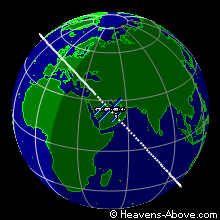
I was out satellite hunting again and I wanted to point out the interesting phenomenon that allows us to actually see satellites at night. As you can see from the image below, the International Space Station was over the Arabian peninsula. The solid line represents the path over the Earth where the ISS would be illuminated by the sun, while the dashed line represents the time when the Earth blocks sunlight to the ISS and it is not illuminated. Because the ISS is (currently) 343 km above the surface of the Earth, it is illuminated for a longer period of time even when the surface of the Earth below is dark. Thus, while the sun has set in Greece in the globe below, the ISS could see be seen over Iraq. This allows us to see objects, depending on their altitude, for about 2 hours after sunset and two hours before sunrise.
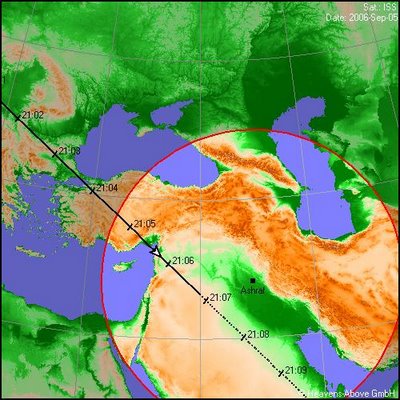
 The next picture below is a closeup of the globe above. As you can see on the chart, at approximately 21:07, the ISS passed out of the sun's illumination. This is interesting to watch, as well. You might think that the bright ISS moving across the sky just disappears, but it does not. The intensity of the ISS begins to fade until you can't see it anymore. This takes place over a period of 15-20 seconds.
 The final picture below is a sky chart which helps you to locate the ISS in reference to known star constellations (and in this case, the Moon and Jupiter). Referencing the chart, I saw that the ISS would become visible below Ursa Major (the Big Dipper) and travel just past Arcturus (in the constellation Bootes; Arcturus' magnitude of -0.05 makes it one of the brightest stars in the sky). As Heavens Above says: This chart shows the path of the satellite across the sky. Please note that East and West are NOT the "wrong way round" if you hold the chart over your head to correspond to the view of the sky.
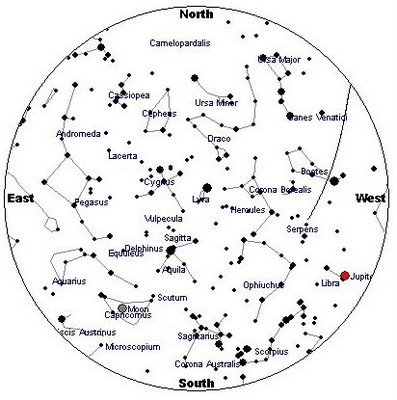 All images are from Heavens Above.
 The next picture below is a closeup of the globe above. As you can see on the chart, at approximately 21:07, the ISS passed out of the sun's illumination. This is interesting to watch, as well. You might think that the bright ISS moving across the sky just disappears, but it does not. The intensity of the ISS begins to fade until you can't see it anymore. This takes place over a period of 15-20 seconds.
 The final picture below is a sky chart which helps you to locate the ISS in reference to known star constellations (and in this case, the Moon and Jupiter). Referencing the chart, I saw that the ISS would become visible below Ursa Major (the Big Dipper) and travel just past Arcturus (in the constellation Bootes; Arcturus' magnitude of -0.05 makes it one of the brightest stars in the sky). As Heavens Above says: This chart shows the path of the satellite across the sky. Please note that East and West are NOT the "wrong way round" if you hold the chart over your head to correspond to the view of the sky.
 All images are from Heavens Above.
04 September 2006
Astronomy update
Satellites spotted tonight: International Space Station and Cosmos 2263 Rocket. Tried to locate the Tropical Rainfall Monitoring Mission (TRMM) but no luck there.
Conditions: a waxing gibbous moon exacerbated by haze.
I also spotted a third satellite that passed overhead at approximately 2043 (local) and the opposite direction of the Cosmos 2263 Rocket. I couldn't find anything of a magnitude 4.5 or brighter on the charts, so it's either dimmer than that (doubtful since I could see it on a hazy night) or its not on the charts for one reason or another.
19 August 2006
Satellite update

The ISS was to appear about an hour after sunset, so there was still some glow left over from the sun. However, its reported brightness was to be -1.7, basically brighter than anything else in the sky. And it didn't disappoint.
Right on cue (I shouldn't be amazed that the satellite predictors are accurate), the ISS appeared above the southwestern horizon. Initially it wasn't as bright, but passed by Virgo (or Jupiter, I couldn't tell) and continued to brighten. As it passed, it was by far the brightest object in the sky.
I tried to find Lacrosse 2, but it was dim (3.4), it was hazy, and pretty low on the horizon. No such luck.
I did however find another: the Cosmos 2214 Rocket which was also 3.4. It passed right by the Big Dipper, and then close to overhead, so even as dim as it was, I was able to find it (barely!).
18 August 2006
The heavens above
I find myself looking up at the stars quite a bit. The sky is hazy, and it's gotten cloudy lately, both of which obscure good viewing. Nonetheless, I still do it.
This is a product of delivering papers as a boy before the sun came up. I would walk for a block or two, staring at the stars and then realize I walked that far without delivering any papers!
My biggest fascination was finding satellites. It's really not that difficult. Generally, they look about the same brightness as other stars, with the only difference being that they are moving! Of course, to see a satellite, it must be illuminated by sunlight when you're looking at it.
I found a pretty cool website called Heavens Above which is essentially a satellite tracker. This is not the only website of its kind, but I found it to be very user friendly. Once you fix your location, you can query the location of specific satellites or find what satellites happen to be crossing over your head at any particular time.
One of the brightest objects you can find is the International Space Station. I saw that it was to pass within my field of view last night, so I set my watch to remind me (it passes almost directly overhead tonight). I also found another satellite (Lacrosse 2, see also here), which is actually a reconnaissance satellite, was also set to pass over about 30 minutes later (and will also pass over tonight).
The hazy sky is getting worse, and the ISS was less than 30 degrees above the horizon, but it was bright enough to find pretty easily. And just as the site predicted, it passed out of the sunlight and disappeared to watching eyes.
Thirty minutes later, Lacrosse 2 was to pass into sunlight almost directly overhead (which definitely helped, because it is further from the horizon haze and it was a full magnitude dimmer than the ISS). Again I picked it up almost immediately, and followed it across the sky until it faded into the haze.
I am certainly not an astronomer, but I think it's pretty cool not only to be able to see a particular satellite (or space station for that matter), but to actually locate it and know with certainty its identity. I'll try using my camera tonight, but I am not a photographer either, and without some sort of amplification, I doubt anything will show up.
Subscribe to:
Posts (Atom)